WiFi Plant Sensor vs Bluetooth Plant Sensor: Which Is Better for Houseplants?
Most smart plant sensors promise easier plant care. But the connection type — Wi-Fi or Bluetooth — can completely change how useful the sensor feels in everyday life.
This guide explains the real difference between Wi-Fi plant sensors and Bluetooth plant sensors, when each one makes sense, and why remote plant monitoring can be a better choice if you want alerts, history and less guesswork.
- Understand the difference between Wi-Fi and Bluetooth plant sensors
- Learn which option is better for remote monitoring and alerts
- See why connection type matters for real indoor plant care
- Find out when a Wi-Fi smart plant sensor like Vprobe makes more sense
A simple guide to help you choose the right smart plant sensor for your home.

Wi-Fi is usually better if you want your plant to update you.
Bluetooth plant sensors can be useful for occasional checks when your phone is nearby. Wi-Fi plant sensors are usually better for remote monitoring, cloud data, smart alerts and checking your plants when you are away from home.
Bluetooth plant sensor
Best for simple local checks when you are physically near the plant and do not need remote updates.
Wi-Fi plant sensor
Best when you want the sensor to send readings through the internet and support remote plant care.
Best everyday choice
For most busy plant owners, a Wi-Fi plant sensor is more useful because it does not depend on manual Bluetooth syncing.
The sensor reading is only useful if you actually receive it.
A plant sensor can measure soil moisture, light, temperature or humidity. But if the data only appears when you open the app near the plant, you may still miss the moment when your plant starts to struggle.
This is where Wi-Fi and Bluetooth behave very differently. Bluetooth is short-range and usually depends on your phone being nearby. Wi-Fi allows the plant sensor to connect through your home router and send readings to the app through the cloud.
- If you are at home and nearby, Bluetooth may be enough
- If you want remote checking, Wi-Fi is usually more practical
- If you want alerts while away, Wi-Fi gives the app more useful data access
- If you have several plants, Wi-Fi can reduce manual checking
The key question
Do you want to check your plant only when you remember, or do you want your plant sensor to help alert you when something changes?
If you want the second option, Wi-Fi plant monitoring is usually the stronger choice.
Where Bluetooth plant sensors work well
Bluetooth plant sensors are not bad. For some users, they are simple, affordable and good enough. The important thing is knowing their limits before buying.
Bluetooth can be a good fit if…
- You only have one or two plants
- You are usually near the plants
- You are happy to open the app manually
- You do not need remote monitoring
- You mainly want occasional soil moisture checks
But Bluetooth can feel limited when…
- You are away from home
- You forget to sync readings
- You want alerts without standing near the plant
- You own several plants in different rooms
- You want cloud history or smart-home style monitoring
What Wi-Fi plant sensors do differently
A Wi-Fi plant sensor connects to your home Wi-Fi network, usually using 2.4 GHz Wi-Fi. This lets the sensor send plant readings through the internet, so the app can receive updates without your phone needing to be next to the plant.
For plant owners, this can make a big difference. Instead of remembering to scan or sync, you can use the app to check plant conditions and receive alerts when readings suggest something needs attention.
- Better for remote plant monitoring
- Better for smart plant-care alerts
- Better for checking plants while travelling
- Better for multiple rooms or multiple plants
- Better for cloud history and connected care features

WiFi plant sensor vs Bluetooth plant sensor
The best choice depends on how you care for your plants. Use this table to compare the real everyday differences.
| Feature | Bluetooth Plant Sensor | Wi-Fi Plant Sensor | Why it matters |
|---|---|---|---|
| Connection range | Short range, phone nearby | Connects through home Wi-Fi | Wi-Fi is better when plants are in different rooms or you are away. |
| Remote monitoring | Usually limited | Yes, when online | Useful when travelling, working or checking plants away from home. |
| Manual syncing | Often needed | Usually not needed | Less manual effort means fewer missed readings. |
| Plant-care alerts | Limited by sync behaviour | Better suited for alerts | Alerts are more useful when the app can receive data without you standing near the plant. |
| Battery life | Can be efficient | Depends on signal and update rate | Wi-Fi uses more power, but good design and strong signal can keep battery life practical. |
| Setup | Often simple pairing | Requires Wi-Fi name and password | Wi-Fi setup can take slightly longer, but gives more connected features. |
| Best for | Simple nearby checks | Connected plant monitoring | Choose based on whether you want occasional checking or ongoing plant care guidance. |
| Smart-home potential | Limited | Better potential | Wi-Fi data is easier to connect with dashboards, automations and smart routines. |
Choose Bluetooth for simple checks. Choose Wi-Fi for connected care.
Both types of sensor can help, but they solve different problems.
Choose a Bluetooth plant sensor if…
- You only want to check readings when you are nearby
- You do not mind opening the app next to the plant
- You do not need cloud monitoring
- You do not need alerts while away from home
- You want a very basic plant moisture sensor experience
Choose a Wi-Fi plant sensor if…
- You want to check your plant remotely
- You want alerts before plant stress becomes visible
- You have several plants or plants in different rooms
- You want plant history, cloud data or app-based guidance
- You want plant care to feel more automatic and less manual
Vprobe was designed for plant owners who do not want to keep checking manually.
Vprobe is a Wi-Fi smart plant sensor because plant care does not only happen when your phone is next to the pot. Your plant may become too dry, too wet, too cold or too dark while you are busy, at work or away from home.
By using Wi-Fi and the Vplants app, Vprobe helps turn plant readings into clearer care guidance and notifications.
- No manual Bluetooth syncing
- No extra hub required
- Wi-Fi cloud monitoring
- Plant-specific care guidance in the Vplants app
- Remote checking when Vprobe is online
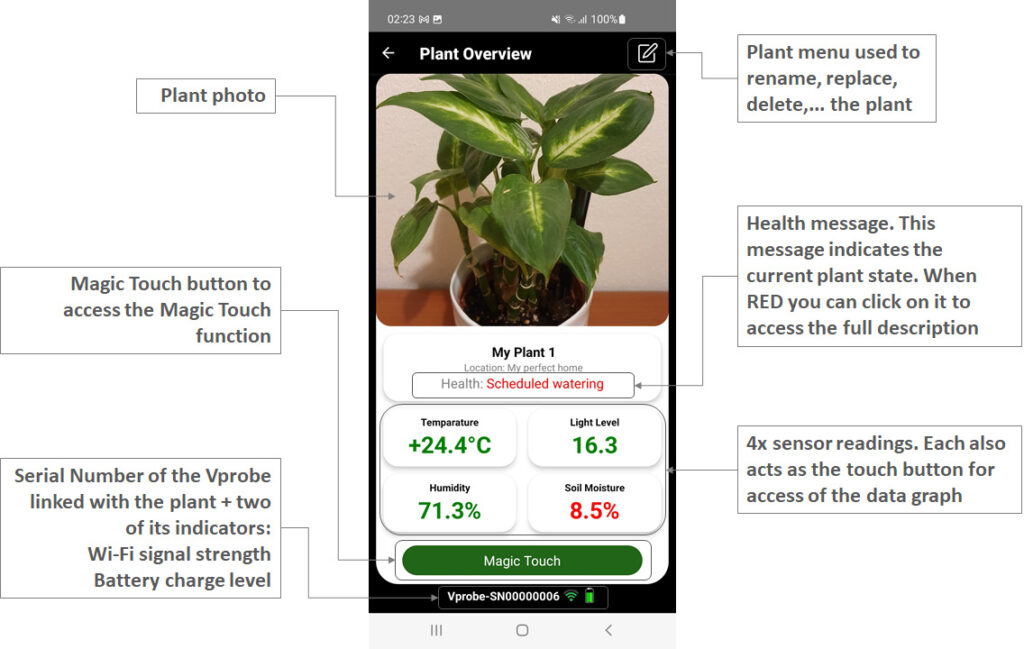
More than a basic plant moisture sensor
Vprobe works with the Vplants app to monitor the main conditions that affect indoor plant health, then helps you understand what your plant may need.
Soil moisture
Helps avoid overwatering, underwatering and root stress.
Light level
Shows whether your plant is receiving enough light in its current position.
Temperature
Tracks air and soil temperature so you can spot cold or hot conditions.
Humidity
Useful for tropical houseplants, calatheas, orchids, ferns and humidity-sensitive plants.
Fertility / EC
Helps monitor nutrient strength in the soil. Learn how EC fertility works →
Smart alerts
Receives plant-care alerts through the Vplants app when your plant needs attention.
Learn more before choosing your plant sensor
These guides explain how Vprobe works, how to set it up, and how to understand plant-care readings.
WiFi vs Bluetooth plant sensor questions
Is a Wi-Fi plant sensor better than a Bluetooth plant sensor?
A Wi-Fi plant sensor is usually better if you want remote monitoring, cloud data and alerts when you are not standing near the plant. A Bluetooth plant sensor can be enough for simple nearby checks.
Do Bluetooth plant sensors work when I am away from home?
Usually not in the same way as Wi-Fi sensors. Bluetooth is short-range, so readings often depend on your phone being near the plant to sync data.
Does Vprobe use Bluetooth?
No. Vprobe is designed as a Wi-Fi smart plant sensor. It connects through Wi-Fi, so plant data can be sent to the Vplants app without manual Bluetooth syncing.
Does a Wi-Fi plant sensor need an extra hub?
Vprobe does not need an extra hub. It has built-in Wi-Fi and connects to a compatible home Wi-Fi network.
Can a Wi-Fi plant sensor send plant-care alerts?
Yes. A Wi-Fi plant sensor is better suited to alerts because it can send readings through the internet when online. The app can then notify you when a plant needs attention.
Which plant sensor is best for beginners?
Beginners often benefit from a Wi-Fi plant sensor because it reduces manual checking and helps explain plant conditions through app guidance and notifications.
Is Wi-Fi better for multiple houseplants?
Wi-Fi can be more convenient for multiple plants because each sensor can send data without needing your phone beside every pot. One Vprobe monitors one plant pot.
Choose the plant sensor that keeps you informed.
If you want more than occasional nearby readings, Vprobe gives you Wi-Fi plant monitoring, Vplants app guidance and smart plant-care alerts without Bluetooth syncing or an extra hub.
If you want your plant sensor to keep working in the background while you are busy, travelling or away from the plant, Vprobe is designed for that exact use case.
Official store or Amazon • UK-based support • Wi-Fi connected • No extra hub required